 SafeAeon Inc
1 day ago in Technology & IT Services
SafeAeon Inc
1 day ago in Technology & IT Services
High Authority Social Bookmarking Site for UAE SEO in 2026 - A2Bookmarks UAE
Welcome to A2Bookmarks UAE, a premier social bookmarking site designed for discovering and sharing the latest trends in the UAE. Our social bookmarking site for the UAE offers an engaging and seamless experience, created specifically for the UAE community. Explore popular local content on one of the leading UAE social bookmarking sites for 2026, save your favorite websites, and connect with like-minded individuals. With our intuitive interface, you can effortlessly categorize and access your bookmarks, while our vibrant community keeps you updated with relevant content. Whether you are looking for top business resources, trending entertainment, or essential local services, our platform helps you organize and discover the best of the web among the top social bookmarking sites in the UAE. Join the A2Bookmarks UAE community today to streamline your online browsing and stay ahead with curated content through the best social bookmarking sites for the UAE market.
8 Types of Social Engineering Attacks and How to Prevent Them safeaeon.com
SafeAeon Inc
1 day ago in Technology & IT Services
Cybercriminals don’t usually need to hack through security breaches.
Sometimes it’s less complicated to persuade someone to volunteer access.
That’s the concept behind social engineering attacks. Attackers control humans to reveal passwords or authenticate access. They can additionally trick employees into transferring cash or opening malicious documents.
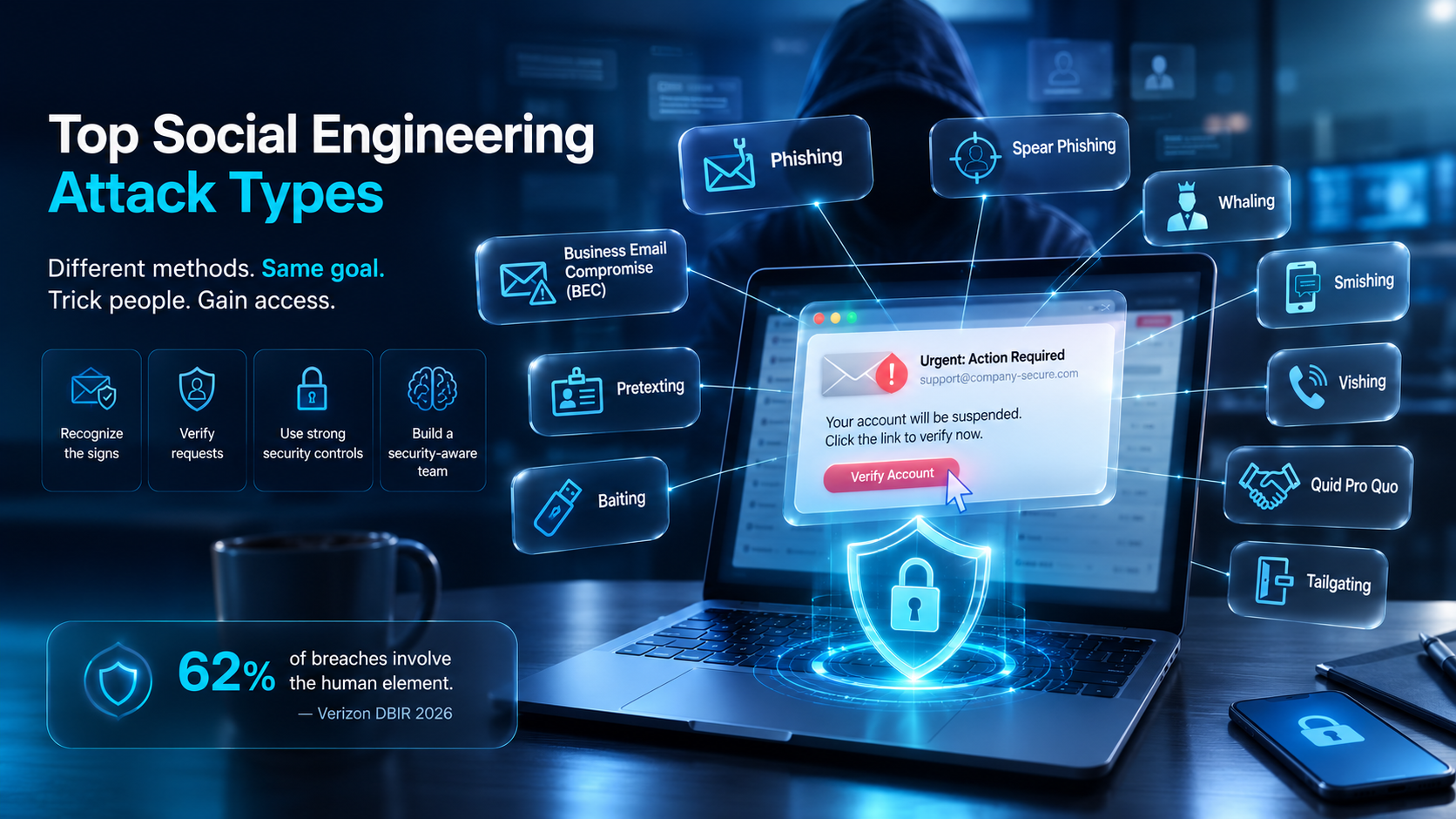
In 62% of the breaches analyzed in Verizon’s 2026 Data Breach Report, human details proved to be essential.
Understanding how social engineering works can help employees recognize an attack before it works.
What Is Social Engineering?
Social engineering is one of the ways attackers use to control humans to take dangerous actions.
The attacker can also impersonate a person the victim trusts instead of breaking the device immediately.
An attacker can be spoofed by:
- A coworker
- An executive
- A customer
- An IT support employee
- A trusted company
The goal may be to steal credentials or gain access to devices. In some cases, the attacker wants the victim to exchange money.
CISA identifies phishing as a form of social engineering in which attackers use fraudulent messages or malicious websites to shorten records.
Why Do Social Engineering Attacks Work?
Most social engineering attacks create a reason for the victim to act quickly.
The attacker can also use urgency or authority. Some attacks depend on interest or anxiety.
For example, a contractor may be notified that their account can be deactivated without logging in without delay.
The login page looks real. The request sounds urgent. Employees enter the password before accessing the website.
Social engineering works because the attacker has human behavior instead of creating the easiest targets.
8 Common Types of Social Engineering Attacks
1. Fishing
Phishing is one of the most unusual social engineering techniques.
Attackers send fraudulent emails that appear to be returned from a dependent utility. The message may also contain a malicious attachment or a link to a fake website.
A phishing message might say that:
A password has expired
Couldn’t bring a bottle
The bill requires an estimate .
One wants account confirmation
CISA warns that phishing can use dangerous links or attachments to steal data or infect smartphones.
2. Spearfishing and whaling
Spear phishing is a targeted form of phishing.
Instead of sending the same message to thousands of people, the attacker researches a specific man or woman. The message may also refer to the role or company of the employee.
Whaling is a form of spear phishing that targets executives or other high-paying targets.
These attacks can be harder to identify because the messages contain records that appear to be valid for the client.
3. Smising and Vishing
Phishing is not limited to email.
Smishing involves the use of SMS or messaging platforms.
Vishing involves the use of phone or voice messages.
The attacker can additionally name a worker and pretend to work for IT support. They may say there’s a problem with the contractor’s account and ask for login credentials.
Mobile-based social engineering deserves special attention. Verizon’s 2026 DBIR comments that mobile devices show higher click-through rates for those attacks than traditional email.
4. Business Email Agreement
A business email contract, or BEC, typically includes an entry of a business enterprise touch dependent.
The attacker can also impersonate a government or merchant.
A common example is an email where a financial group asks to exchange payment information.
The message also appears legitimate because the attacker has researched the business campaign. In some cases, the attacker can also change the email account itself already.
BEC often has economic fraud instead of malware.
5. Excuses
The pretext is about building a credible story to get or access records.
The attacker can pretend to be a worker who is misplaced gaining access to an account.
They could then contact the support team and request a password reset.
When identity verification strategies are weak, this attack method can be particularly powerful. CISA accidentally documented the use of social engineering by actors to convince help desk employees to reset passwords or MFA tokens.
6. Temptation
The temptation gives the victim something enticing to do so.
The attacker may offer free software programs or valuable downloads.
The provider directs the user to a malicious Internet site or swollen notification.
Physical temptation also arises.
For example, an attacker could leave an infected USB drive where an employee might find it and connect it to a computer.
7. Payment
A quid pro quo attack gives you something to go back to or access for data.
The attacker may pose as a technical assistant and offer to clean up the computer problem.
Instead, the individual may be asked to provide login credentials or configuration software.
A payment appears to be offered upon request, which may make the victim much less suspicious.
8. Playback
Not all social engineering attacks happen online.
Behind it is an attack on physical defense.
An unauthorized person follows an employee into a restricted space. The attacker can pretend to have forgotten to gain access to the card or definitely ask someone to hold the door.
Once inside, the attacker can gain advantage to gain access to to gadgets or touching areas.
Therefore, body protection can be part of protection awareness.
Warning Signs of Social Engineering
Social engineering attacks look different, but several warning signs appear repeatedly.
Be cautious when a message:
- Creates unusual urgency
- Requests passwords or sensitive information
- Asks for an unexpected payment
- Contains an unfamiliar link
- Requests an MFA approval you did not initiate
- Comes from an unusual sender
- Discourages you from verifying the request
One warning sign does not automatically mean a message is malicious.
However, unusual requests should be verified through another trusted communication channel.
How to Prevent Social Engineering Attacks
Organizations cannot rely on employee awareness alone.
People need training, but technical controls should support them.
Use Security Awareness Training
Employees should learn how phishing and impersonation attacks work.
Training should include realistic phishing simulations. It should also explain how employees can report suspicious requests.
CISA recommends training employees to recognize phishing attempts and report them quickly.
Enable Multi-Factor Authentication
MFA adds another verification step beyond a password.
If a password is stolen, MFA can make unauthorized access more difficult. CISA recommends MFA for systems such as email and remote access.
Phishing-resistant MFA provides stronger protection where supported.
Protect Business Email
Email protection can block malicious links and attachments.
It can also help identify confused senders or unusual message behavior.
Restrict User Access
Employees must ideally have access to the systems required for their role.
If the account is compromised, restricted privileges can reduce what an attacker can access.
Verification of sensitive requests
Payment adjustment and password reset should be a pure authentication strategy.
Another communication channel can help diagnose unusual requests.
Final Thoughts
Social engineering attack targets agree on the location of the most effective generation.
However, phishing is still a big problem, and companies need to combine BEC and phone-based attacks. Physical processes should also no longer be deleted.
The most powerful protection combines worker awareness with identity security and email security. Continuous protection monitoring can provide a second layer of security once an attacker has exceeded the initial monitoring.
SafeAeon helps organizations deliver improvements in these areas through managed email security and MFA offerings. Security awareness training and 24×7 security monitoring can further help reduce the spread of social engineering attacks.
voters
Report Story 
Related Stories









Recent Stories