 Kanhasoft LLP
2 months ago in Technology & IT Services
Kanhasoft LLP
2 months ago in Technology & IT Services
High Authority Social Bookmarking Site for UAE SEO in 2026 - A2Bookmarks UAE
Welcome to A2Bookmarks UAE, a premier social bookmarking site designed for discovering and sharing the latest trends in the UAE. Our social bookmarking site for the UAE offers an engaging and seamless experience, created specifically for the UAE community. Explore popular local content on one of the leading UAE social bookmarking sites for 2026, save your favorite websites, and connect with like-minded individuals. With our intuitive interface, you can effortlessly categorize and access your bookmarks, while our vibrant community keeps you updated with relevant content. Whether you are looking for top business resources, trending entertainment, or essential local services, our platform helps you organize and discover the best of the web among the top social bookmarking sites in the UAE. Join the A2Bookmarks UAE community today to streamline your online browsing and stay ahead with curated content through the best social bookmarking sites for the UAE market.
When Is the Right Time to Upgrade Your ERP Software? kanhasoft.com
Kanhasoft LLP
2 months ago in Technology & IT Services
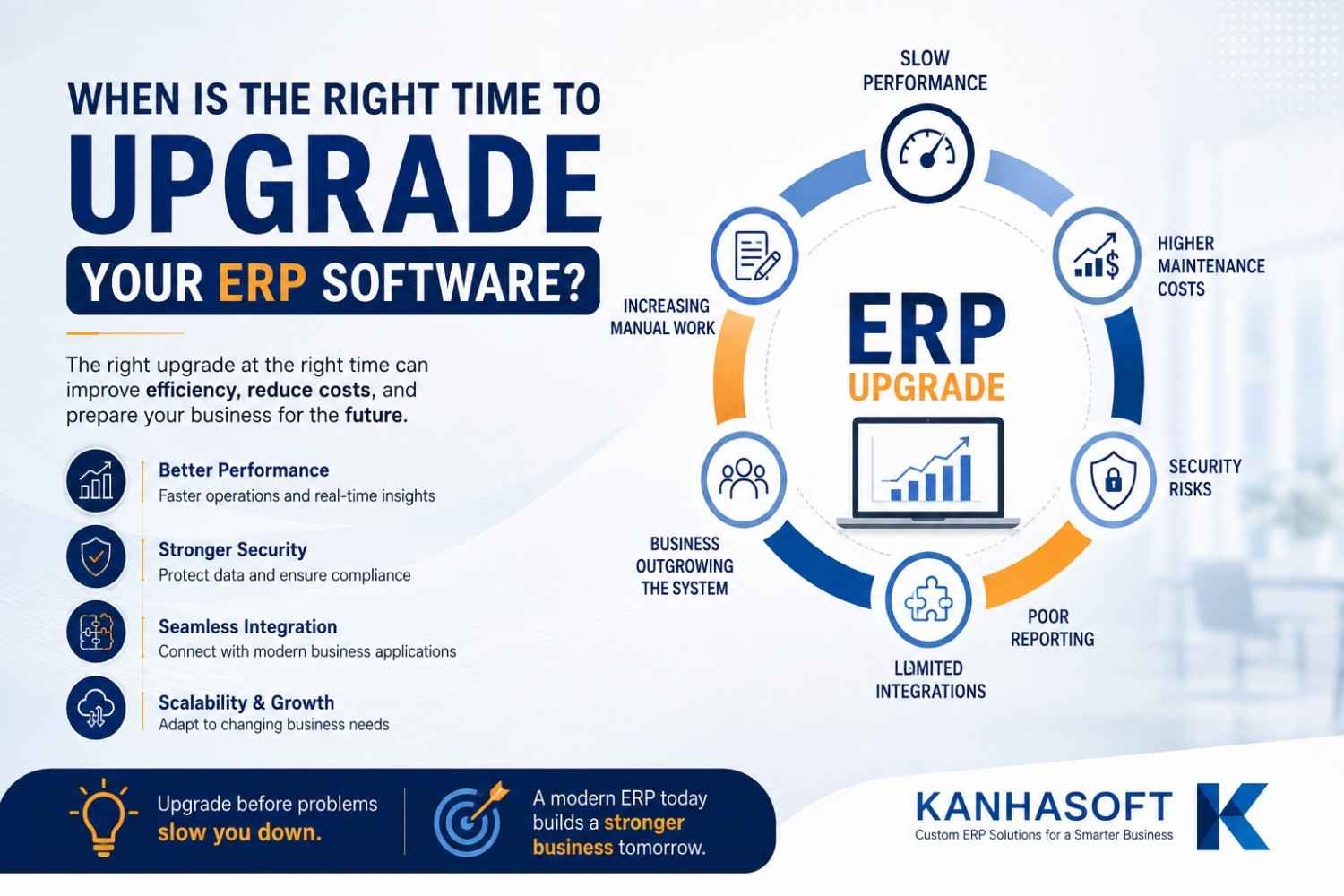
Every business reaches a point where its software starts showing its age—even if it faithfully handled operations for years. We have seen organizations hesitate to modernize because the existing system still “works.” However, working and working efficiently are two different things. An outdated ERP can quietly slow productivity, limit growth, and create unnecessary costs. The right decision is rarely about following technology trends; it is about supporting business goals. In this guide, we explore the signs that indicate when an ERP upgrade becomes the smartest investment for future success.
Quick Answer
The right time to upgrade your ERP software is when it no longer supports your business efficiently, securely, or competitively. Common warning signs include slower performance, increasing manual work, poor integrations, rising maintenance costs, and limited reporting capabilities. Waiting until systems fail often leads to higher expenses and operational disruptions. Planning improvements before those problems become business risks helps organizations stay productive, scalable, and prepared for future opportunities. A well-timed modernization strategy always delivers greater value than an emergency replacement.
Why Businesses Delay ERP Upgrades
Many companies postpone ERP improvements because change feels risky. Concerns about downtime, employee training, project costs, and implementation complexity often outweigh the visible problems of an aging system. We completely understand that hesitation—it resembles driving a reliable car while quietly ignoring the warning lights on the dashboard. Eventually, those lights stop being suggestions and become expensive reminders. Delaying modernization may feel like saving money today, but the hidden costs usually grow faster than expected, making future transitions more complicated than necessary.
1. Your ERP Is Slowing Down Daily Operations
Speed matters in every department. When employees wait longer for reports, inventory updates, or financial transactions, productivity gradually declines. Slow systems create frustration that spreads across the organization and often results in unnecessary workarounds. Teams may not immediately recognize how much time disappears every week until faster technology is introduced. If your ERP regularly struggles during peak business hours or requires frequent restarts, those delays are clear indicators that the software can no longer keep pace with your operational demands.
2. Manual Work Is Increasing Instead of Decreasing
ERP software exists to automate repetitive business processes. If employees continue relying on spreadsheets, duplicate data entry, handwritten approvals, or manual reporting, something is no longer working as intended. Over time, these extra steps increase human error and reduce efficiency. We often notice businesses creating temporary fixes that eventually become permanent routines. Unfortunately, those routines consume valuable hours every week. When manual work begins replacing automation, it signals that your ERP needs modernization rather than additional shortcuts.
3. Your Business Has Outgrown the Existing ERP
Business growth is exciting, but older software does not always celebrate with you. Expanding into new markets, opening additional offices, hiring more employees, or adding product lines places greater demands on operational systems. An ERP designed for yesterday’s business model may struggle with today’s requirements. Growth should create opportunities instead of software limitations. If teams frequently hear phrases like “our system cannot do that,” it may be time to evaluate whether your ERP still aligns with your long-term business objectives.
4. Integrations Have Become Difficult
Modern businesses depend on connected technologies. Customer relationship management platforms, eCommerce websites, payroll systems, business intelligence tools, and third-party applications all need reliable communication. When integrations require complicated workarounds or custom scripts just to exchange information, efficiency quickly declines. Data silos begin appearing across departments, creating inconsistencies and delays. A modern ERP should simplify connectivity rather than complicate it. If connecting new software feels like solving an impossible puzzle, your current platform may have reached its practical limits.
5. Security Risks Keep Growing
Cybersecurity standards continue evolving, while older ERP systems often struggle to keep up. Unsupported software may no longer receive security patches, leaving organizations exposed to vulnerabilities and compliance risks. Data protection regulations have also become more demanding across industries. Protecting customer information and business records requires stronger security controls than many legacy systems can provide. Rather than waiting for security incidents to expose weaknesses, businesses should proactively modernize their ERP environment to reduce risk and maintain confidence among customers, employees, and stakeholders.
6. Reporting Takes Too Long
Business decisions are only as good as the information behind them. When managers spend hours compiling reports from multiple sources instead of reviewing real-time insights, valuable opportunities can disappear. Delayed reporting often leads to delayed decisions, affecting inventory planning, budgeting, and customer service. We have seen businesses celebrate finally generating a report—only to realize the numbers were already outdated. Modern ERP platforms provide faster analytics and interactive dashboards, helping decision-makers respond confidently instead of reacting after problems have already grown.
7. Employees Constantly Complain About the System
Your employees interact with the ERP every day, making their feedback one of the clearest indicators of system health. Frequent complaints about confusing navigation, slow performance, or repetitive tasks should never be dismissed as routine workplace frustration. Productivity naturally declines when people spend more time fighting software than completing meaningful work. A modern ERP should simplify operations, not create additional obstacles. When experienced employees invent workarounds just to finish simple tasks, it is often a sign that modernization has become necessary.
8. Maintenance Costs Are Increasing Every Year
Legacy ERP systems may appear less expensive because the original investment has already been made, but ongoing maintenance often tells a different story. Custom fixes, aging infrastructure, expensive vendor support, and compatibility issues can gradually consume IT budgets. Instead of funding innovation, businesses end up paying to keep outdated technology operational. We often compare this to repairing an old machine every month—it still runs, but every repair delays the inevitable. Investing in modernization can reduce long-term operational expenses while improving overall business performance.
9. Your Industry Regulations Have Changed
Regulatory requirements evolve continuously, particularly in industries such as healthcare, manufacturing, finance, and retail. Older ERP platforms may struggle to support updated compliance standards, reporting requirements, or security expectations. Relying on outdated software increases the likelihood of audit findings, compliance penalties, and operational disruptions. Businesses should regularly evaluate whether their ERP aligns with current industry regulations instead of assuming yesterday’s compliance remains sufficient today. Staying proactive protects both organizational reputation and customer trust while reducing unnecessary business risks.
10. Your Competitors Are Moving Faster
Technology has become a competitive advantage rather than simply an operational necessity. Organizations using modern ERP platforms often introduce products faster, automate routine processes, improve customer experiences, and respond quickly to market changes. Meanwhile, businesses relying on aging systems may struggle to match that pace. Competition rarely slows down to accommodate outdated software. If competitors consistently deliver faster services, better insights, or greater operational efficiency, your ERP may be limiting growth more than market conditions or business strategy ever could.
Common Risks of Waiting Too Long
Postponing ERP modernization creates challenges that often remain hidden until they become expensive problems. Productivity gradually declines, maintenance costs continue increasing, and security vulnerabilities become more difficult to manage. Employees lose confidence in systems that slow their work, while customers may experience delayed service or inaccurate information. Perhaps the greatest risk is losing business opportunities because decision-makers cannot access reliable data quickly enough. Addressing software limitations early is almost always less disruptive than responding to unexpected failures under significant operational pressure.
Benefits of Upgrading ERP at the Right Time
Modern ERP solutions offer far more than updated interfaces. Businesses gain improved automation, stronger security, real-time analytics, simplified integrations, cloud accessibility, and greater scalability. Employees spend less time performing repetitive tasks and more time focusing on strategic initiatives that drive measurable growth. Decision-makers benefit from accurate information delivered when it matters most. A carefully planned modernization also prepares organizations for future technologies, allowing them to adapt more easily as business requirements continue evolving instead of constantly playing catch-up.
ERP Upgrade vs. Complete ERP Replacement
Not every organization requires an entirely new ERP platform. Sometimes upgrading existing modules, improving integrations, or migrating to newer versions provides everything needed for continued growth. However, if the software no longer supports core business processes, lacks vendor support, or demands extensive customization just to function, replacement may be the better long-term investment. The decision should always balance business objectives, implementation costs, operational complexity, and future scalability rather than focusing solely on immediate expenses or technical preferences.
How to Prepare for an ERP Upgrade
Successful ERP modernization begins long before implementation starts. Businesses should evaluate current challenges, define measurable objectives, review existing workflows, clean outdated data, and involve stakeholders across departments. Employee training deserves equal attention because even the best technology delivers limited value without confident users. Thorough testing before deployment helps identify issues while minimizing operational disruptions. Planning each phase carefully creates smoother transitions, reduces unexpected costs, and ensures the upgraded system supports both immediate priorities and future business growth effectively.
Common ERP Upgrade Mistakes to Avoid
Many ERP modernization initiatives encounter avoidable challenges because organizations underestimate the planning required for a successful transition. Rushing implementation, migrating outdated or inaccurate data, providing limited employee training, and reducing testing timelines can all affect project outcomes. Another common mistake is choosing technology without first understanding business requirements or working with an experienced ERP software development Company that can recommend the right approach. A successful ERP upgrade balances technology with business objectives through careful planning, clear communication, and ongoing stakeholder involvement, helping businesses reduce risks and maximize their long-term return on investment.
voters
Report Story 
Related Stories










Recent Stories